
What Test Data Confirms 6101 Aluminum Busbar High Conductivity Performance?
What Test Data Really Proves 6101 Aluminum Busbar Conductivity
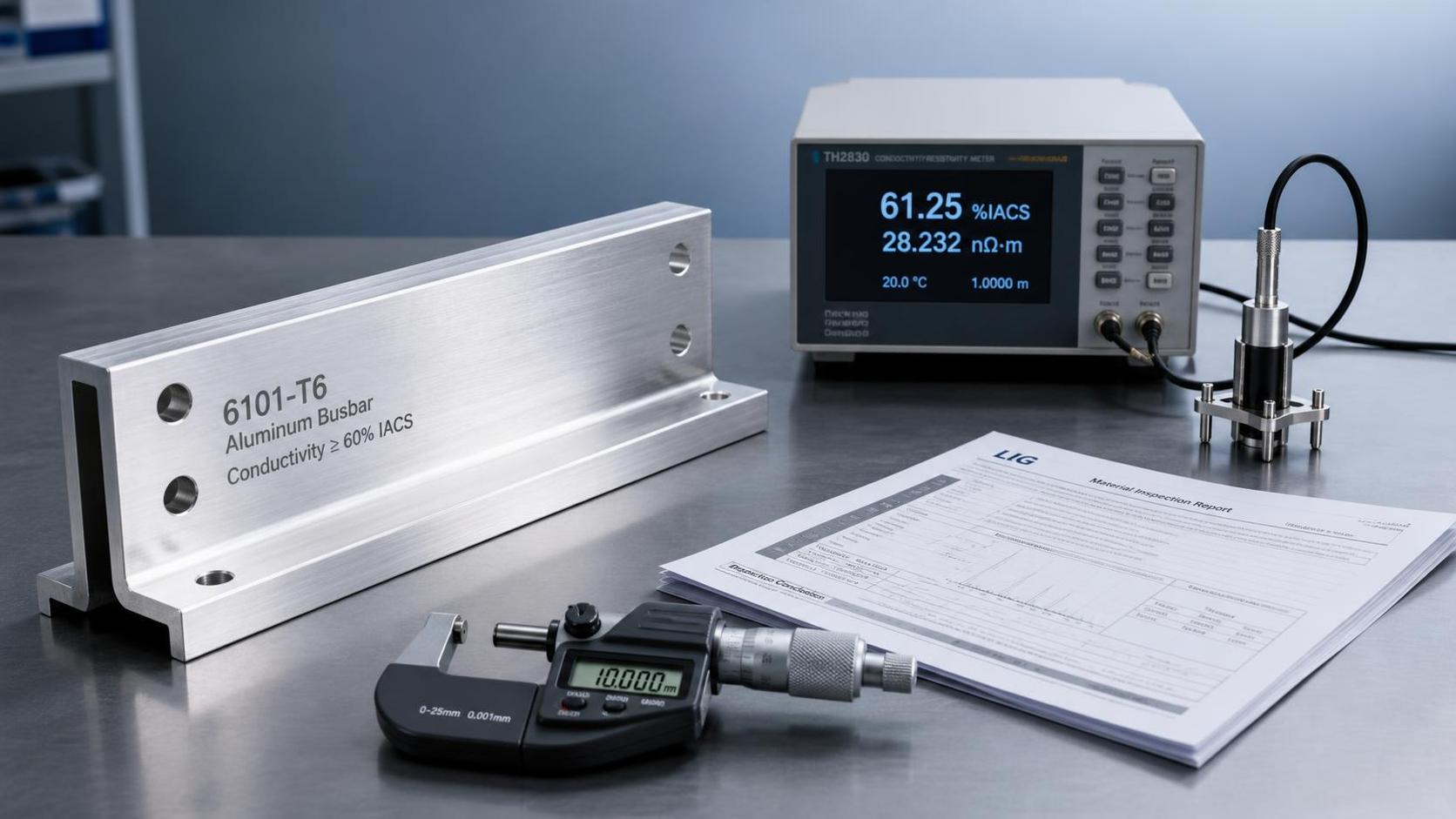
If a supplier says a 6101 busbar has “high conductivity,” that statement is not enough for release approval or safety sign-off. In practice, 6101 aluminum busbar high conductivity is confirmed by a group of test results, not one number on a brochure. The most useful data usually comes from electrical conductivity testing, resistivity calculation, dimensional verification, mechanical property checks, and evidence that the material and process stay consistent from lot to lot.
For quality teams, the first document to ask for is the mill or inspection report showing conductivity or resistivity values for the delivered temper and section size. Conductivity is commonly reported as a percentage of IACS, while resistivity may be shown in micro-ohm units. Either format can work, but it has to be traceable to the actual batch. A lab result taken from a different thickness or different temper does not tell you much about the busbar on your floor.
The core tests that matter
In most factory acceptance reviews, four checks carry the most weight:
- Electrical conductivity test on the finished material
- Resistivity confirmation, especially when comparing suppliers
- Tensile strength and elongation, because conductivity alone is not enough for busbar reliability
- Dimensional tolerance and surface quality, which directly affect joint resistance and heat rise
This is where people sometimes make a wrong turn. A busbar can meet conductivity expectations and still perform poorly in service if the contact surfaces are uneven, the oxide layer is not controlled, or the cross-section varies beyond tolerance. In high-current cabinet interconnection or grounding structures, those small manufacturing deviations can show up later as local heating at bolted joints rather than failure in the body of the bar itself.
Why conductivity data should be read with mechanical data
6101 is often selected because it balances electrical performance with better structural capability than very high-purity aluminum grades. That trade-off is useful in busbar systems, especially where the bar also needs structural adaptability during equipment assembly. But it also means the review cannot stop at conductivity. If the temper raises strength, conductivity may shift; if the process prioritizes softness for bending, dimensional stability may change. Good QC judgment looks at those interactions rather than chasing a single “best” value.
Thermal behavior also deserves attention. A busbar with stable conductivity and good thermal conductivity is easier to manage under continuous load, but thermal performance is still system-dependent. Joint design, enclosure airflow, coating, and installation spacing all affect temperature rise. For that reason, some buyers ask for heat-rise or current-carrying validation at assembly level, not only raw material test data.
What standards and production records should support the test report
Test data is more convincing when it is backed by production discipline. Manufacturers with controlled smelting, casting, extrusion, and inspection procedures generally produce more repeatable conductivity results than shops relying on broad nominal claims. This is one reason experienced buyers review not just the certificate, but also the supplier’s process stability, raw material control, and full inspection logic. Companies such as Shandong Jinhao Aluminum, which combine R&D, production, deep processing, and after-sales support under standardized quality control, are usually in a better position to provide traceable documentation across the full production cycle.
It also helps to compare 6101 with other alloy routes used in the market. In some applications, buyers may also evaluate 1060 / 1070, 6063, or 6061-T6 depending on whether the priority is current transmission, lower system weight, corrosion resistance, or mechanical rigidity. A practical reference point can be seen in solutions from an Aluminum busbar manufacturer serving power distribution, new energy, rail transit, and industrial electronics, where alloy choice is tied to operating conditions rather than marketing labels.
A useful acceptance mindset
When reviewing 6101 aluminum busbar high conductivity claims, ask a simple question: does the test data reflect the finished busbar you will actually install? If conductivity values are clear, resistivity is consistent, mechanical properties fit the design, and the supplier can show stable process control, the claim is on much firmer ground. If those pieces are missing, “high conductivity” is just a phrase. For safety-critical distribution work, that is not a small distinction.
Navigation
Send Us A Message
Professional field of aluminum bars
24/7 before-sales and after-sales services
Comprehensive technical support